
Next.js vs Vite: Which to Choose?
Comparing two of the most popular React frameworks in 2026.
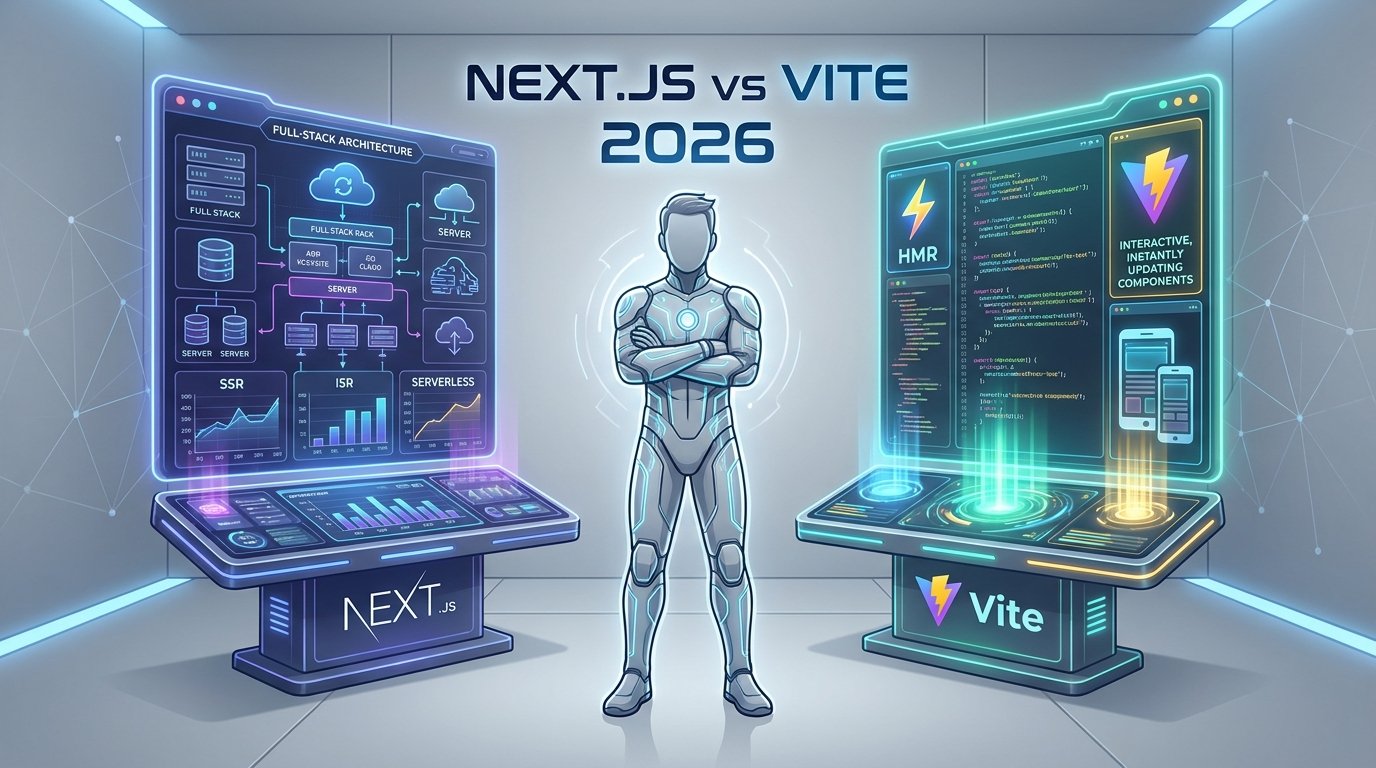
The JavaScript ecosystem moves quickly, and nowhere is this more evident than in the React world. As we look ahead to 2026, two dominant forces have emerged, each powering incredible digital experiences but catering to slightly different project philosophies and needs: Next.js and Vite.
Choosing the right foundation isn't just about technical specifications; it’s about aligning your framework with your project’s goals, team expertise, and long-term vision. At RAAQ, we understand the importance of making this crucial decision. Let's delve into a detailed comparison, navigating the evolved landscapes of both Next.js and Vite to help you select the optimal path for your next future-focused application.
The Full-Stack Powerhouse: Next.js (2026 Edition)
Next.js, especially with its continuous innovation, remains the definitive choice for comprehensive, server-rendered and full-stack React applications in 2026. It has solidified its position as the go-to solution when robustness, out-of-the-box optimization, and deep full-stack integration are paramount.
Evolved Capabilities for Complex Applications:
Hybrid Rendering Dominance: Next.js has further perfected its hybrid rendering capabilities. Whether your application demands pure Server-Side Rendering (SSR) for real-time data, Static Site Generation (SSG) for unparalleled speed and predictability, or Incremental Static Regeneration (ISR) for efficiently updating static content, Next.js provides granular, per-page or even per-component control. This is framed by the maturity of Server Components (and Server Functions/Actions) in 2026, which have become more powerful and intuitive, enabling seamless data fetching and server-side logic directly within your React components without complex API layer definitions for many common patterns.
Advanced Automatic Optimizations: From font and image optimization to sophisticated bundling and code-splitting, Next.js automates countless performance best practices. By 2026, these features are incredibly sophisticated, leveraging advanced build-time and runtime intelligence to ensure maximum end-user performance with minimal developer effort. Your applications are inherently fast, responsive, and optimized for both users and search engines.
Robust Full-Stack Integration: Next.js 2026 continues to simplify full-stack development. Built-in API routes, powerful server components/functions, and tight integration with edge functions and serverless databases mean you can develop, deploy, and scale comprehensive full-stack applications within a single, cohesive framework.
When to Choose Next.js (2026 Scenarios):
You are building a large-scale, content-rich, or data-driven enterprise application.
Strong SEO and organic visibility are absolute requirements (e.g., e-commerce, news sites, marketing platforms).
Your project benefits significantly from server-side rendering, advanced optimization defaults, and a deeply integrated full-stack architecture.
You value comprehensive, opinionated tooling and a vast, established ecosystem that streamlines full-stack complexity for large teams and projects.
The Agile Front-Runner: Vite (and the Ecosystem it Powers)
Vite, initially rising to prominence for its blazing-fast development experience (DX), has matured into much more than just a build tool by 2026. While still prioritizing developer speed, it has become a powerful foundation powering a diverse ecosystem of meta-frameworks and highly optimized Single Page Applications (SPAs).
Outstanding Development Experience and Flexibility:
Unrivaled Speed: Vite’s core strength remains its incredible speed during development. Near-instant Hot Module Replacement (HMR) means that changes are reflected in your browser practically in real-time, drastically reducing friction and boosting developer productivity. Builds are efficient and optimized, leveraging native ES modules for rapid startup and lean bundles for production. In 2026, this speed is further enhanced, making the feedback loop practically imperceptible.
Lightweight and Versatile Core: Vite provides a lean, flexible build tool foundation with minimal initial framework opinion. While opinionated meta-frameworks (some of which may have even evolved specifically for React using Vite by 2026) offer Next.js-like capabilities, using Vite directly or with minimal opinion provides experienced teams with greater control over application architecture, routing choices, and backend integrations.
Vibrant and Diverse Ecosystem: Vite powers not just React but many other frameworks. This means improvements to Vite itself benefit a massive, diverse community. The ecosystem of plugins and integrations is vast and rapidly growing, allowing you to tailor your Vite-based React project precisely to your needs.
When to Choose Vite (2026 Scenarios):
You are building a highly interactive Single Page Application (SPA) where maximum client-side interactivity and perceived performance after initial load are critical.
Prioritizing extreme developer speed and immediate feedback loop is paramount for your team’s agility.
Your project has a flexible architecture requirement, and you prefer a leaner, less opinionated foundation with more granular control over ecosystem choices and backend integrations.
You are working on a smaller to mid-sized project, rapid prototype, or highly focused client-side application where complex server-side complexity is unnecessary or handled by a separate API layer.
Head-to-Head Comparison: Nuances in 2026
Performance ( nuanced context): Both frameworks deliver exceptional performance in 2026, but often in different ways. Next.js excels at end-user performance for content-heavy/SEO apps due to optimized pre-rendering and server components. Vite shines with perceived runtime performance for highly dynamic SPAs after initial load, potentially delivering leaner client-side bundles initially and unparalleled developer speed. The best choice depends entirely on your application’s specific usage patterns and critical performance metrics.
Features & Complexity: Next.js is an all-in-one, integrated full-stack solution. Vite is a powerful build foundation plus a flexible ecosystem. Next.js manages more complexity for you out-of-the-box, making it ideal for large, comprehensive projects. Vite offers more architectural freedom, which can be advantageous for specific niches or highly experienced teams but might require more configuration and decision-making around integration for full-stack features.
Ecosystem and Community: Both have vast, active communities. Next.js, with Vercel's enterprise focus, boasts arguably the largest, most cohesive React-specific ecosystem, with abundant resources, support, and tightly integrated tools. Vite's community is incredibly vibrant and diverse, spanning multiple frameworks, offering unparalleled variety and rapid innovation but perhaps with a more fragmented (though rich) landscape for purely React-centric solutions compared to Next.js's vertical integration.
The RAAQ Perspective and Verdict: It Comes Down to Project Goals
There is no single "winner" in the Next.js vs Vite comparison in 2026. Both are powerful, mature, and future-proof. The ideal choice hinges entirely on your specific project requirements, team skillset, and business goals.
At RAAQ, we pride ourselves on helping clients make smart technology decisions that drive success. Our expert React developers possess deep experience in leveraging the unique strengths of both Next.js and Vite across diverse applications. Our approach is tailored, crisp, and focused on delivering premium digital experiences. We can partner with you to:
Evaluate: Assess your specific project goals against the evolved capabilities of Next.js and Vite 2026.
Consult: Provide detailed, project-specific recommendations on the optimal framework and architecture.
Execute: Build, optimize, and scale your application, maximizing performance, robustness, and speed, consistent with our clean gray and glowing blue aesthetic philosophy.
Whether you need the all-in-one robustness of Next.js for a complex enterprise platform or the blazing speed and flexible agility of Vite for a highly dynamic SPA, RAAQ is here to guide you.
Ready to select the perfect React foundation for your future digital success? Contact RAAQ today to explore how our expertise can accelerate your project's potential.
